The era of AI has arrived and stirred up the world with stunning demos, bold predictions, heated debates, ingenuity, stupidity, fear, hope, and, of course, a market craze. In other words, all the usual things that make humans humans.
Once in a while, our customers ask us what we at EasyMorph think about AI and how we envision the application's future in the turbulent AI era. This post answers that question.
How I understand AI
Disclaimer: I view "AI" as a marketing term that nowadays is exclusively used to describe the functionality enabled by large language models (LLMs) — extremely advanced neural networks. Artificial intelligence is a much broader discipline with its ups and downs over its long multi-decade history. Nevertheless, I'll use "AI" throughout the post as popular marketing jargon for what it describes.
I see LLMs … (cough) … AI as a massively transformational technology with extremely long-term consequences. It's a new computational principle that is, most importantly, practically usable (unlike, say, quantum computing). The previous one of this scale was when the currently dominant computational principle was solidified by the von Neumann computer architecture proposed in 1945 and has defined how computers work since then. You don't discover new practically usable computational principles every day. Things like that happen once in a lifetime! By all means, this is huge.
AI easily solves a whole lot of computational challenges, difficult or practically impossible for traditional computation based on deterministic, precise algorithms. That difficulty is well explained in this comic https://xkcd.com/1425, but with AI it's no longer actual.
The wonderful ability of LLMs to make what was computationally impossible possible led to a Cambrian explosion of attempts to use AI in all possible ways — good, bad, and ugly. Today, the technosphere whirls at top speed, propelled by investor money, and rest assured, we will see many dramatic AI-related ups and downs in the following years.
One thing I'd like to make clear: it's naive to think that the real impact of technological advances of this scale becomes quickly evident. It will take years until we start understanding the long-term consequences of this technological breakthrough and learn how to use it right. To put it into perspective, what we're seeing currently in AI applications is akin to the computers of the 1950s that just introduced the first transistors and magnetic disk storage.
There are still many open questions regarding AI, and not only technical ones. For instance:
Do AI providers own the copyright for AI outputs? Do they bear responsibility for the advice offered by AI? It's well known that AI crawlers scrape all of the internet and largely ignore copyright. Can AI users be the target of a lawsuit because of that?
A big open question is whether AI leads to increased work productivity. Of course, there is an abundance of self-reported claims of increased productivity, and many people state that AI has made them multiple times more productive. However, when it comes to early research of possible productivity gains, the picture is much less rosy. One of the studies demonstrated "uneven impact of artificial intelligence (AI) capabilities, where AI assistance improves performance for some tasks but worsens it for others".
All in all, the current state of AI is still largely experimental, and there still are many unknowns. This experimental phase will eventually lead to separation of the wheat from the chaff, the correct from the wrong. But until then it's still all mixed up, and I'm afraid too many people hurry with bold, loud statements about AI.
Which brings us to…
The AI hype
As with any ground-breaking technological advance, you would expect it to come with a wave of hype. What you probably didn't expect is the sheer amount of AI-related nonsense that flooded media and social feeds.
Some people call it "AI hysteria", but I think it's disrespectful to AI enthusiasts who have many good reasons to be excited about the new technology. I share part of this enthusiasm and honestly believe that we will see many wonderful, useful examples of applying this technology in the following decades. It will just take time to understand what really brings value in a long-term perspective and what doesn't. Seeing numerous people jump to big conclusions after they vibe-coded their first app might be annoying, but this shall pass.
However, even before those wonderful times arrive, we can already make a few interesting takeaways from observing how people react to and use AI:
First of all, it's a huge validation of self-service, because AI (especially agentic AI) is inherently a self-service technology. AI has demonstrated that people (especially less technical ones) are striving for self-service and have always been. People want not just computer literacy, they want computer agency! They don't want to always ask the IT guys to help them. They want to do it themselves, and AI gives them this capability (to some extent).
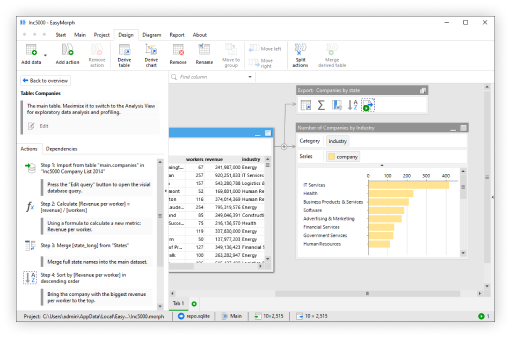
We understand it very well, because EasyMorph has been a self-service data tool from day 1, and self-service is at the core of our mission (recently expanded).
It's encouraging to see another proof that despite all the criticism and dismissal, the potential for self-service is barely untapped. The opportunity is huge.
Another conclusion: people are tired of the complexity of (enterprise) apps. Chatbots and conversations in natural language seem easy to understand and approachable for people with any technical skill set. No more need to scratch their head while trying to figure out how to do something in the unintuitive, cumbersome user interface of yet another poorly designed enterprise app. Just ask the AI!
Again, UI complexity fatigue is another key consideration for us when we design EasyMorph. Are chatbots a solution to the UI complexity? I suspect it will take us some time to re-learn why graphical user interfaces came into existence after decades of dealing with the command line, and why SQL wasn't adopted by non-technical people (for whom it was initially intended). But I might be wrong.
What's wrong with the AI hype
If it wasn't clear until this point, I'm in the camp that is annoyed by the AI hype. The wrong incentive it creates is clearly visible and ugly: sensational public statements about AI (intentionally) drive up valuations of companies related to AI. Click-hungry social media enthusiastically spread the sensational statements. Shareholders put pressure on the executives to respond to what seems to be a massive trend. The executives put pressure on the employees to do whatever it takes to present their companies as "AI-first" or "AI-driven" or whatever it takes to drive the share prices up quickly.
That wrong incentive inevitably results in many half-baked (or outright wrong) uses of AI in organizations and software applications. That's how we get AI for the sake of AI, and we definitely want to avoid this in EasyMorph.
A good example of how not to design products around AI I encountered just a few days ago:
I received an email with a meeting proposal listing a few available times. Google Gemini popped in and offered to create a calendar meeting with the sender. "Add to Calendar" was a suggested prompt, so I went ahead and clicked it. The AI bot created a meeting, but, to my disappointment, the meeting overlapped with other meetings already booked in my calendar, despite Gemini having access to my calendar. Did I really have to explain things that should go without saying?
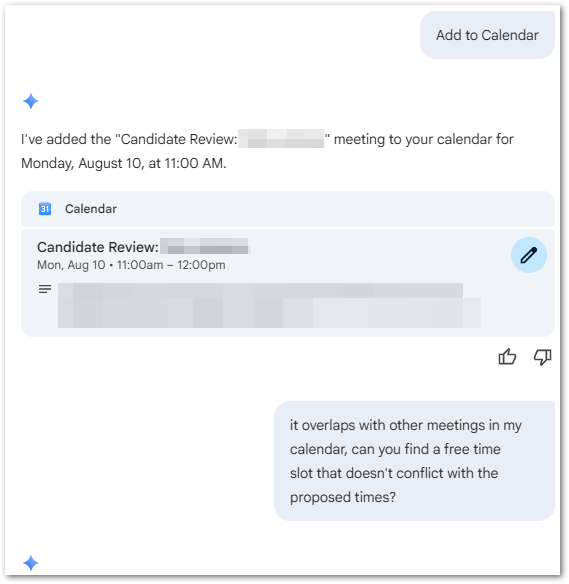
The rest of the conversation wasn't better: instead of finding a free time slot, it wrote a long explanation of why the suggested time won't work (useless information I didn't ask for but wasted my time reading). And when I asked it to create a meeting at a specific time and also invite Sheryl, my colleague, it created the meeting and confirmed that Sheryl was invited. However, when I double-checked it, Sheryl wasn't on the list of invitees. Gemini lied (another fail).
This, ladies and gentlemen, is not how one should make software products. The underlying technology doesn't matter if the product doesn't understand what the user needs and the usual conventions s/he operates with.
Another example, and I do it for fun once in a while, is when I see an AI bot in some application I ask it to tell me the best alternative to the application and the reasons to switch it. In other words, I ask the bot to sell me a competitor. Never did I get a "no". All AI bots were eager to recommend me the competition. Isn't that funny?
While this is a half-serious example, it nevertheless demonstrates what happens when application developers don't have proper control over the external technology to which they delegate communication with their main and most precious asset — their customers. A more serious case of the same problem led to a lawsuit against Air Canada that the airline lost.
Another example of poor application of AI in software applications, this time in data & analytics:
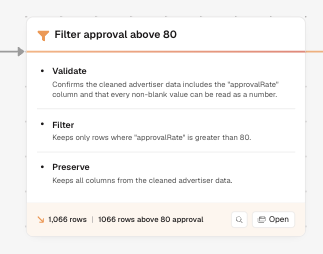
A cloud-based data preparation tool (technically, our competitor) struggled to produce a working model of AI-powered visual data preparation. After a few obviously wrong attempts, such as sending all data in LLM prompts on every workflow run (ouch!), in their next attempt to do things smarter they started generating "black boxes" — AI-generated parts of workflow that look like a box with input, output, and a short description of the kind of transformation it performs. That's it. Astonishingly, the application doesn't offer any way to see the actual logic inside the box (I suspect it's just auto-generated Python code). So you can't see what exactly it does, you can't edit it, and you can't reuse it (for instance, for tests). Effectively, it's "just trust me, bro!".
We don't want EasyMorph to be like the examples above.
What the data & analytics industry gets wrong about AI
Perhaps the biggest misconception is that the technical work of clicking buttons to create a design is the most time-consuming effort, and thus AI will make you 10x more productive because it will design ETL workflows and create data visualizations for you. This understanding is obviously incorrect for anyone who spends a non-trivial amount of time analyzing and transforming data. As one of our customers wrote to me recently: "For a new team member, the main challenge is usually not how to build a workflow, but how to understand the underlying data structures and business logic." The mechanical work of dragging tools in an ETL workflow, or configuring a chart is never the most time-consuming part. It's the thinking and reasoning about data and business logic.
I totally get why the idea of delegating thinking to AI is so attractive. Thinking is hard! It takes calories. The entire history of human evolution is dictated by the human body's struggle to preserve energy. The idea of getting something done without thinking too much about it is extremely appealing from a biological point of view, supported by millions of years of evolution. The lizard brain screams, "Let the AI think about that for you"!
The problem with data analytics is that you ought to have a mental model of your data in order to reason about it. Creating this mental model is the hardest thing, and sorry, you can't delegate it to AI unless you're OK with bearing the consequences of losing control over the correctness of your data calculations.
To reason about data, and to create a mental model of it, you need to be able to see, explore, and understand your data. All of it. You can't understand data and reason about it if you see only part of it. For instance, if you see only a few top rows in a key column, you don't know if the column has duplicate keys or not. And when you do a join on this key column, you don't know if the join is correct, because the key might not be unique, but you don't know it. I call it "the lack of data visibility".
Unfortunately, when it comes to data transformation, the vast majority of dataprep/ETL applications don't provide data visibility readily. You have to fight them to get a bit of it, and sometimes you lose this fight. Applications like PowerQuery and ETL tools like Alteryx, KNIME, SSIS, Talend — all of them provide poor data visibility by design. With cloud ETL tools like Fivetran, it gets even worse — the data you need to explore resides on someone else's machine, possibly far away, and the latency introduced by that separation makes good data visibility practically impossible.
Now a simple question: if a data tool doesn't provide data visibility by design, will AI fix that? The answer is, of course, no. AI can't fix what is deficient in principle. Instead of solving the problem of data visibility and helping users create the mental models (the hard problem), the data & analytics industry has largely chosen to follow the easy path and slap GenAI on top of something that is inherently deficient (aka "putting lipstick on a pig").
Another problem with AI-generated designs, be it workflows, dashboards, or charts, is clarity. Imagine AI has generated a data preparation flow based on your prompt. Yay, mind-blowing! But what makes you think it's correct? Is it only because this particular output looks correct? What makes you sure the workflow will produce the correct result for a slightly different set of input data (e.g., when you run it with next month's data)? What if it produces the correct result only for this particular input dataset? Are you going to trust AI blindly (aka "just trust me, bro")?
We at EasyMorph have been experimenting with AI-generated workflows for a good couple of years. It works. Sometimes surprisingly well. Better and better as LLMs develop. So the technology is here. The reason why you still don't see it in the application is that we're still looking for ways to make it a good product. For instance, it should be able to clearly explain what was generated. We don't want to add AI features just to impress someone for a few moments. We want to make a good, lasting, reliable product for our audience, because I know that a big part of our audience is business professionals without a technical background. Just throwing at them a 50-step auto-generated workflow with loops, parameters, and advanced actions, and letting them figure out on their own whether it's correct or not would be a half-baked, poorly designed product powered by AI just for the sake of it. Exactly the kind that we now see everywhere. Thank God we're not a public company, so we are not under pressure from shareholders and market analysts riding the AI hype. We can afford not giving a damn and focusing on what really matters — great user experience. Not everyone has this luxury.
We're discussing internally and experimenting with other use cases for LLMs, but this post is already getting too long, so I won't go into much detail here.
To wrap it up, our focus hasn't moved even the smallest bit with the arrival of AI. Unlike some other software companies, we haven't hastily abandoned our product strategy just because AI came into existence. We still believe in what we do, and we're still devoted to solving the problem of data preparation — an "eternal problem" that existed 10, 20, 50 years ago and will exist as long as people have to deal with data. The need for visual, deterministic, repeatable, private, and verifiable data preparation isn't going anywhere, and I don't see anything else that can address this problem better than EasyMorph. If/when we see an opportunity to make EasyMorph non-trivially better by using LLMs, rest assured we will (like we’ve already done with automated expression generation). But even now, I believe it's the best data tool for data analysts and data engineers, because of the data visibility, privacy, and speed it offers.
If you have never seen it, you should try it. Download the forever-free edition today.